



Companion article
Story breakdown and lore notes
The video above is the main focus of this page. The written companion, supporting images, and lore breakdown continue below.
A Hidden Civilization Older Than Empires
Ixtal is one of the most mysterious regions in all of Runeterra. Hidden deep within the jungles of the Shuriman continent, it is a land defined by isolation, pride, and overwhelming mastery of elemental magic. While much of the world sees Ixtal as some forgotten corner of the map, the truth is far older and far greater than that.
This was once one of the first great civilizations to stand beside Shurima, a nation whose culture may have helped shape some of the earliest foundations of Runeterra itself. And that pride still lives on in the heart of Ixtal today.
No one embodies it more openly than Qiyana. "One throne, nine sisters. Nine tragic accidents waiting to happen." That single line says everything about her. Ruthless ambition, absolute confidence, and a belief that power belongs to the one strong enough to seize it. Qiyana does not dream of serving Ixtal. She dreams of ruling it.
She even says it herself: "Empress Qiyana... I do like the sound of that." And then pushes the idea even further. "Someday, all this will be Ixaocan. A glorious empire, with an empress to fit."
That is the mindset of modern Ixtal in one voice. A civilization that does not see itself as hidden, weak, or forgotten, but as something greater than the rest of Runeterra. To the Ixtali, the outside world is not more advanced. It is simply younger, lesser, and dangerously reckless. That belief was forged through catastrophe.
Long ago, Ixtal was one of the first independent nations to join the Shuriman Empire. Yet Ixtali culture itself was already ancient, born from the great westward diaspora that also gave rise to peoples like the Buhru, Helia, and the ascetics of Targon. Their knowledge of elemental magic was among the greatest ever known, and many believe Ixtal played an important role in the creation of the first Ascended.
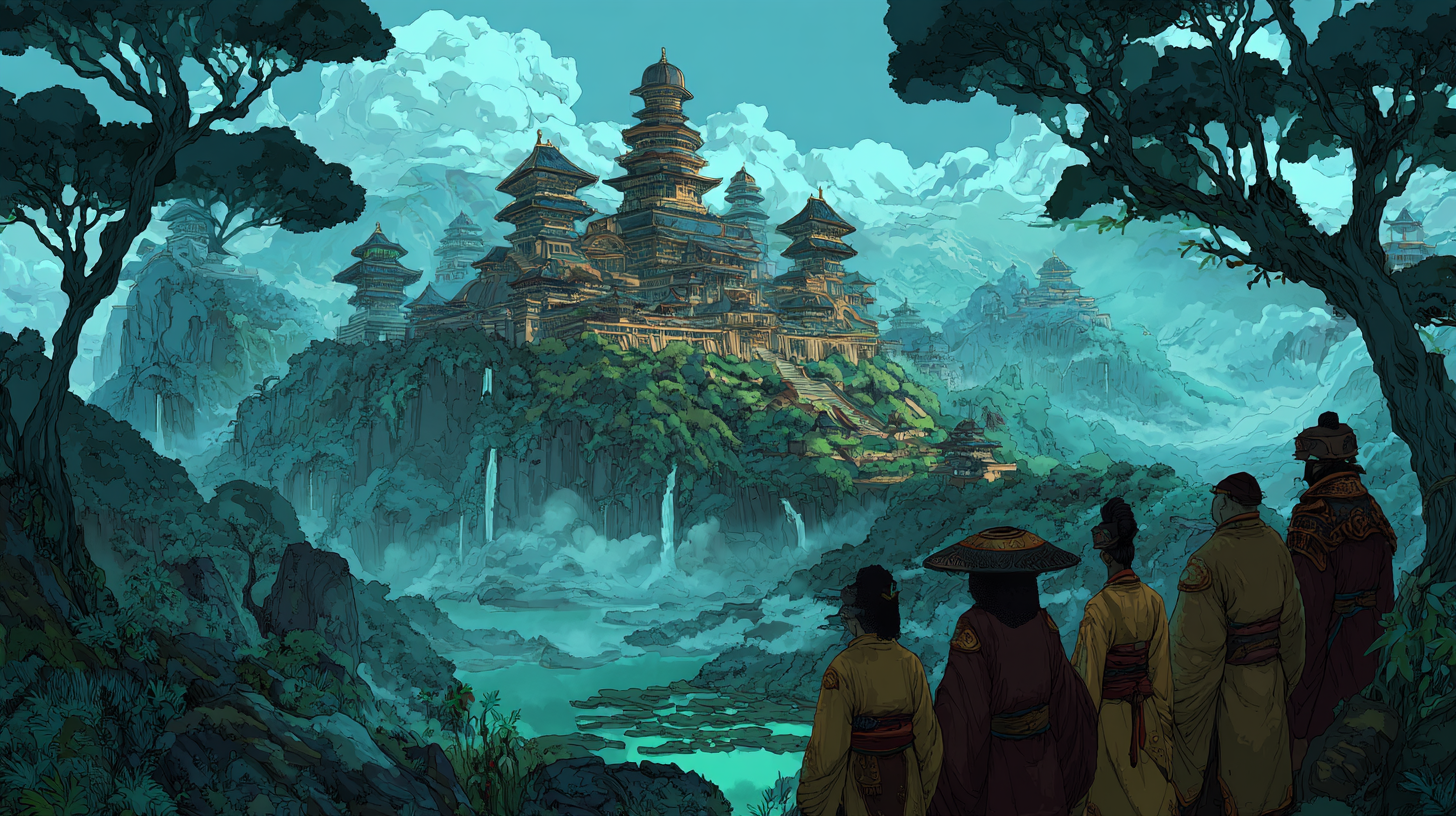
But then came the horrors that shattered the ancient world. The Void. The Darkin. The Rune Wars. While other civilizations were consumed, corrupted, or erased, the mages of Ixtal chose survival through separation. They pulled away from their neighbors and drew the jungle around themselves like a living shield. And no figure stands more at the center of that ancient survival than Skarner.
Skarner and the Founding of Ixaocan
Before Ixtal rose into its full glory, its founders traveled westward into the jungle and unknowingly settled under the watchful gaze of a being far older than any human kingdom. The brackern Skarner observed them in silence, fascinated by what they were building. He watched from afar until disaster struck, a rockslide that threatened to wipe the settlement away. That was the moment Skarner revealed himself. He saved them.
And from that day on, he became more than a guardian. He became one of Ixtal's founders. Skarner reminds us of that ancient duty when he says: "For generations, I have defended Ixtal. I will defend this land, too."
The early Ixtali revered him as protector, and in time Skarner joined them fully. In exchange for their culture and history, he gave them his geomancy, his strength, and his wisdom. Together they raised the great arcology-city of Ixaocan, one of the most sophisticated magical civilizations in Runeterra.
Skarner says: "I am the first Yun Tal, and I will be the last." That line carries enormous weight, because the Yun Tal are the ruling caste of Ixtal, the greatest and most trusted elementalists in their society. Skarner was not just present at the birth of Ixtal's ruling order. He stood at its foundation.
And he tells us how deeply he bound himself to the nation: "I sacrificed everything for Ixtal, and in return, Ixtal has given me its trust."
Yet that trust would not remain unbroken forever. As Shurima expanded, Skarner felt the violence moving across the continent. Through the vibrations in the earth, he sensed the danger of imperial ambition and the destruction brought by the Ascended. So when Shurima offered Ixtal alliance, Skarner opposed it. But the Yun Tal agreed anyway.
The Void, Ne'Zuk, and Malphite's Origin
Then came Icathia's fall. Roughly three and a half thousand years before the present day, the Void broke into the world. The corruption spread outward from Icathia like a cosmic disease, consuming everything in its path. Even the southern jungles of Ixtal were no longer safe. In that terrible age, an Ixtali elemental mage of colossal power rose to answer the threat: Ne'Zuk.
Ne'Zuk forged a weapon unlike anything the world had ever seen, the Monolith, a floating fortress of living stone, the size of a city, carried and sustained by elemental magic and manned by Ixtali god-warriors. It was meant to take the war directly to the Void. And for a time, it did.
The battle that followed was one of the greatest in Runeterra's history. Sorcery powerful enough to erase civilizations was unleashed against the Void. But the Void retaliated with equal horror. The Monolith was scarred and broken by unnatural corruption. Its living stone failed. Its structure collapsed. And in the end, it crashed into the abyss.
Only Ne'Zuk survived. But not all of the Monolith truly died that day. One shard remained buried beneath the earth, forgotten for ages, gathering strength in silence until it awoke alone. That last shard would one day become Malphite.
For Ixtal, the lesson was clear. The outside world brought ruin. Alliance brought ruin. Ambition beyond the jungle brought ruin. So after the Void, and later after the devastation of the Rune Wars, Ixtal closed itself away. Skarner convinced the Yun Tal to hide the region in lies and elemental magic, wrapping its borders in living wilderness.
But though he still loved Ixtal's people, his faith in their rulers was shattered forever. You can hear that bitterness in Skarner's words: "Not all Yun Tal can be trusted: I will silence any who plot against me, against Ixtal." He had seen their failures. He had watched them gamble with the fate of their homeland. And so he came to believe that only he could truly protect it.
That conviction hardens in another of his lines: "Ixtal's enemies, my enemies, will tremble at my name!"
If you're enjoying this journey into hidden Runeterra, lore-lovers, leave a like and subscribe to Liandrug. It helps the channel grow and lets us keep diving into regions, champions, and forgotten powers that could reshape the entire world.
The Yun Tal, Nidalee, Milio, and Life Inside Ixtal
Beneath Ixaocan, Skarner built a hidden chamber. There, attuned to the vibrations of the earth, he listened for every threat that approached his homeland. Over the centuries, he withdrew deeper and deeper into myth, until only the Yun Tal remembered he was still there.
Yet even in isolation, time did not stop. The world outside burned, changed, and rebuilt itself, while Ixtal watched from behind its barrier. And Skarner, ancient beyond measure, gives us that perspective when he says: "I have seen the rise and fall of countless civilizations. This is but one moment among many."
That is Ixtal's gaze upon the rest of Runeterra. Empires rise. Kingdoms collapse. Wars reshape continents. And still the jungle remains. The barrier protecting Ixtal is more than a wall. It is an entire system of elemental misdirection and death. Storms appear without warning. Mist blinds the senses. The land seems to shift and rearrange itself. Vines swallow structures, ships, and people. Travelers vanish without a trace, consumed either by the jungle or by those who defend it.
And the defenders are not all hidden mages in grand arcologies. Ixtal also lives in its villages, in its tribes, in the people shaped by its harsh and proud culture. Nidalee gives us one of the clearest glimpses into that older, more primal side of Ixtal. She tells us: "My tribe calls itself 'the Pakaa'. Only foreign prey call us 'Kashdaji'."
That line matters because it reveals something essential about Ixtal: outsiders do not even understand the names of the people who live there. They arrive with their own labels, their own arrogance, and their own assumptions. But to those born in the jungle, foreigners are not scholars or explorers. They are intruders.
Nidalee makes that even clearer when she says: "I pay no attention to the affairs of men, until they make me their enemy." That is Ixtal's old instinct in its purest form. Leave us alone, and we remain unseen. Threaten us, and the jungle answers.
And she directs that same challenge toward Qiyana herself: "How long can you survive outside your golden palace, princess?" It is more than a taunt. It exposes a divide inside Ixtal. On one side stands the wild, unforgiving reality of the jungle. On the other stands the polished grandeur of Ixaocan and its ruling elite.
That same tension appears again in the story of Milio, but in a much gentler way. Milio shows us another face of Ixtal, not the rulers, not the ancient guardians, not the proud huntresses, but a child standing at the edge of a system that decides who matters and who does not.
The Yun Tal are not simply noble rulers. They are the gatekeepers of prestige, advancement, and belonging. To join them is to rise. To be cast out by them is to fall to the edges of Ixtal's world. And that is why Milio speaks of the Yun Tal with such hope. "Leaving home, joining the Yun Tal. It's all for my family."
For him, this is not ambition like Qiyana's. It is devotion. He also tells us: "When I'm in the Yun Tal, I'm gonna go back home and help my entire village." That line is important because it shows what the Yun Tal represent to ordinary people. Power, yes. But also restoration. Safety. Honor returned to a family that lost it.
Milio even says: "My omele says joining the Yun Tal will make my family happy. And she knows best. Right?" There is innocence in that line, but also pressure. In Ixtal, your future is never yours alone. It belongs to your bloodline, your village, your house, your place in the greater order.
And then comes the confidence of youth. "I'm gonna be the youngest kid to ever join the Yun Tal! Pretty amazing." Through Milio, we see that Ixtal is still alive, still producing dreamers, still creating people who want to belong to something greater.
Qiyana's Future Empire
Deep in the jungle stands the great arcology-city, a system of magical structures connected by intersecting lines of power. Each arcology represents a different discipline of elemental mastery. These are not merely homes, and not simply schools, but entire living centers of magical civilization. At the heart of it all stands the Cardinal Arcology, seat of the Yun Tal, older than the first Sun Disc of Shurima. Beneath it lies Skarner's hidden chamber. At its center hangs the Vidalion, an ancient artifact capable of weaving magic into material form. Around it stand the great disciplines of fire, stone, water, ice, steam, and more, proof that Ixtal never truly declined. It simply withdrew, preserving its greatness behind a veil of myth.
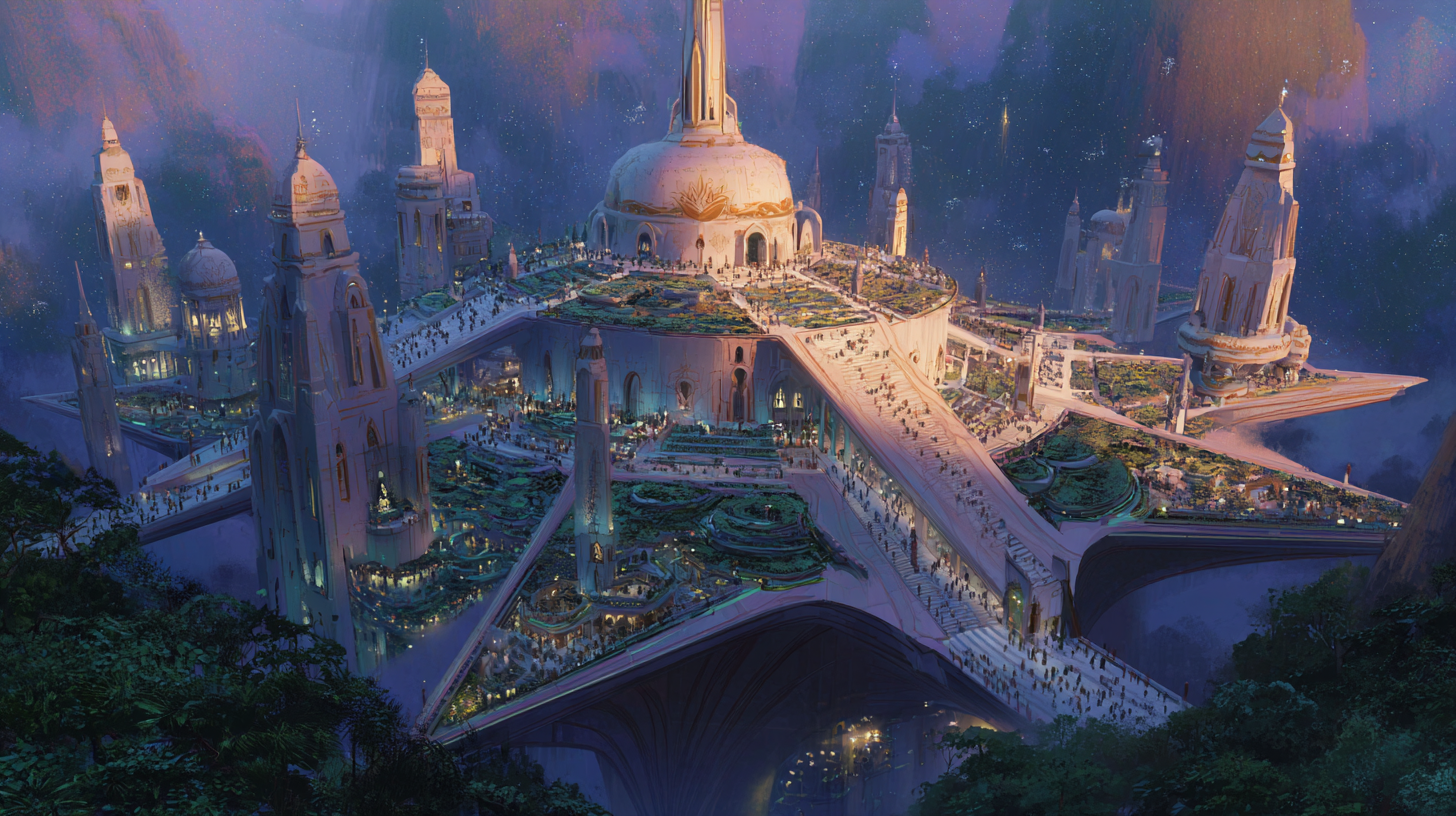
Beyond Ixaocan stretch villages and border settlements: places like Paretha, Semchul, Taarqen, Tikras, Xolen, Ohmka, and Milio's own village. Some are ruled by prefects trusted by the Yun Tal. Some stand at the edges of the hidden nation, where the jungle presses hardest against the outside world. Some have already suffered from contact with outsiders, like Tikras, devastated after Piltover miners brought vengeance into Ixtal's borderlands.
That is why Ixtal remains so hostile to the nations beyond its mist. Noxian expeditions vanish in the jungle. Piltover pushes its reach farther and farther, sometimes with success. Bilgewater adventurers disappear while hunting treasure. And all the while Ixtal watches the rest of the world like a civilization forced to share a planet with children playing with fire.
Even so, the region is not empty wilderness. Its jungles are filled with monstrous reptiles, carnivorous plants, basilisks, elemental dragons nesting among ancient ruins, and floral species as beautiful as they are deadly. Everything in Ixtal feels alive. Everything feels armed.
And somewhere beneath all of it, beneath the roots, beneath the stone, beneath the city itself, Skarner still listens. There is pride in him. Duty. Anger. And perhaps even grief. You can hear all of that in one of his most haunting lines: "I yearn for the days when Ixtal lined the streets to see me... adore me... love me."
That is not just the voice of a protector. That is the voice of a founder who remembers what was lost. A being who helped build a civilization and then watched it grow secretive, fearful, and distant even from him. But ancient sorrow does not make him weak. "I am Skarner of Clan Opal-hin, progeny of broodmother Nixale, and I will be your undoing."
That is the final truth of Ixtal. It is not just a hidden nation of elemental mages. It is not just Qiyana's future empire. It is not just ancient arcologies buried in jungle mist. It is a civilization guarded by old power, shaped by ancient trauma, and sustained by a belief that the outside world cannot be trusted.
Ixtal survived because it chose distance. It endured because it became untouchable. And if the rest of Runeterra ever forces its way too deep into the jungle, it may learn that Ixtal was never lost at all. It was only waiting.
Outro
And that was the story of Ixtal, one of the most ancient, isolated, and dangerous regions in all of Runeterra. If you enjoyed this video, make sure to like, share, and subscribe so more lore-lovers can find the channel and join us on these journeys.
And if you want an even cozier place to talk about lore, theories, characters, and hidden details, then come join our Discord, where we can build a truly welcoming community of lore-lovers discussing the worlds we love. Thank you for being here, and I'll see you in the next story.
Back to Home