



Companion article
Story breakdown and lore notes
The video above is the main focus of this page. The written companion, supporting images, and lore breakdown continue below.
The Chronicle
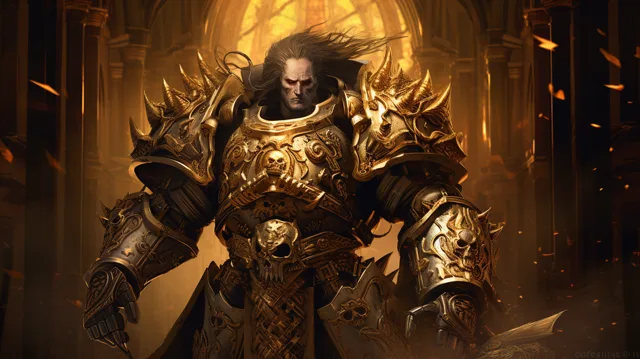
In preparation for the Great Crusade following the Unification of Terra, the Emperor initiated several key projects aimed at expanding and solidifying His dominion across the galaxy.
He established the astropath corps, utilizing telepathy to link his future interstellar empire, and engineered the Astronomican--a psychic beacon powered by His will for safer Warp travel over vast distances.
Central to His plans was the Primarch Project, through which He created 20 superhuman infants using His genetic code as the basis. These primarchs were designed to be unmatched generals and statesmen, possessing unparalleled mental and physical abilities.
To further augment the primarchs, the Emperor tapped into Warp powers acquired at Molech. This imbued them with extraordinary charisma and capabilities but also rendered them susceptible to corruption by Warp entities, posing a significant risk to the Emperor's grand design.
The Emperor's plan to create the primarchs and shape them into powerful leaders was disrupted by the Ruinous Powers, who feared Humanity's potential to unify and challenge Chaos. The primarchs were lost when they were cast into the Warp despite the Emperor's safeguards.
In response, the Emperor adapted his strategy, using genetic samples from the primarchs to create a new breed of warriors--the Legiones Astartes, or Space Marine Legions. These warriors inherited superhuman qualities akin to the primarchs and the Emperor himself.
Leading the Space Marine Legions, originally recruited from Terran adolescents, the Emperor initiated missions to reconquer the Sol System. The Space Marines liberated moons from alien slavers and crucially forged an alliance with the Mechanicum of Mars through the Treaty of Mars in the 30th Millennium. This alliance provided vital technology and resources for the Emperor's Great Crusade into the stars.
Simultaneously, the Treaty of Mars formalized the Imperium of Man and integrated the Mechanicum into the burgeoning Adeptus Terra, solidifying the Imperial bureaucracy on Terra and paving the way for the vast government of the Imperium.
Following the abatement of Warp Storms caused by the birth of Slaanesh and the Fall of the Aeldari, the Emperor commenced the Great Crusade around 798.M30, starting with the First Pacification of Luna.
During the Great Crusade, the Emperor's forces, organized into expeditionary fleets, reclaimed lost Human colonies, defeated alien oppressors, and expanded the Imperium's dominion across the galaxy.
A pivotal aspect of the Great Crusade was the Emperor's reunion with His lost primarch sons, discovered one by one as the expeditionary fleets ventured deeper into uncharted space. Each primarch assumed command of a Space Marine Legion bearing their gene-seed, playing a crucial role in expanding the Imperium.
Together, they brought numerous worlds into Imperial Compliance, imposing the values of the Imperial Truth--an ideology rejecting irrationality and superstition in favor of reason, science, and progress. The Emperor saw this as vital for weakening the foundations of Chaos, which thrived on Human beliefs and emotions.
The Emperor was resolute in his pursuit of the Imperial Truth, which emphasized reason and science while rejecting all forms of religion and superstition. He believed that for Humanity to ascend as the dominant species in the galaxy, every trace of faith and irrational belief must be eradicated.
Even before the Great Crusade, the Emperor personally oversaw the destruction of Terra's last church, engaging in intellectual combat with its priest, Uriah Olathaire, to assert the supremacy of reason over religious dogma.
The Imperial Truth asserted Humanity's rightful place as rulers of the galaxy due to the purity of its physical form and the failures of other alien civilizations. Encounter with hostile or potentially threatening alien species typically resulted in their extermination to ensure Human dominance and safety in the galaxy.
The Emperor advocated spreading the Imperial Truth peacefully but was prepared to enforce it through war if necessary, viewing unity as essential for Humanity's survival against cosmic threats and the corruptive influence of Chaos.
While embracing reason and science, the Emperor prohibited the development of true artificial intelligence, recalling the devastation caused by the Men of Iron during the Dark Age of Technology. Planets found harboring advanced AI were ruthlessly exterminated to prevent the recurrence of catastrophic mistakes from Humanity's past.
The issue of psychic sorcery and the use of psychic powers became a significant concern during the Great Crusade, prompting divisions within the Imperium. The Emperor, as the most powerful psyker in existence, harbored reservations about the widespread emergence of psyker abilities among the Human population.
He recognized the dangers inherent in uncontrolled psychic powers and the susceptibility of individuals to corruption by Warp entities. Many worlds encountered by Imperial forces were found under the sway of Chaos Cults whose members wielded sorcerous psychic abilities granted by daemonic entities.
Primarchs like Mortarion of the Death Guard and Leman Russ of the Space Wolves expressed strong opposition to the use of psychic powers. Mortarion, drawing from his experiences on his homeworld of Barbarus, understood the peril of anything associated with the Warp. Russ, known for his preference for straightforward combat, viewed psychic abilities, particularly those of the Thousand Sons Legion, as dishonorable.
The tension over psychic abilities escalated to the point where it threatened the stability of the Imperium. In response, the Emperor convened an Imperial conclave on the world of Nikaea to address the issue and establish a definitive stance.
The conclave gathered representatives from both sides of the debate, with the Emperor presiding as arbiter in a massive amphitheater. The outcome of the conclave at Nikaea would have profound implications for the future use of psychic powers within the Imperium.
The Council of Nikaea was a pivotal moment in the history of the Imperium, addressing the contentious issue of psychic sorcery and its role within the Imperium. The debate was framed by contrasting viewpoints from advocates like the Witch Hunters and Primarch Magnus the Red, who staunchly defended the use of sorcery.
The Witch Hunters, represented by groups like the Sisters of Silence, highlighted the dangers and horrors associated with uncontrolled psychic powers. They recounted tales of suffering inflicted upon the Emperor's subjects by sorcerers, mutants, and cults aligned with Chaos. They emphasized the catastrophic consequences of uncontrolled psychic abilities during the tumultuous Age of Strife.
On the opposing side, Primarch Magnus the Red argued passionately for the continued use of psychic abilities. He asserted that knowledge itself was neutral, and it was the intent behind its use that determined its morality. Magnus advocated for deeper research and understanding of psychic powers to harness them for the benefit of Humanity.
The debate intensified with the intervention of Space Marine Librarians, who likened psykers to gifted athletes requiring careful education and guidance. They proposed strict training and oversight of psykers by the Imperium to ensure their abilities were used for the service of Mankind while condemning sorcery as heretical and dangerous.
The Council of Nikaea also served as a trial for Magnus the Red, who faced accusations of sorcery and the introduction of sorcerous practices within the Space Marine Legions. Despite Magnus' compelling arguments, evidence of his continued practice of sorcery led to the Emperor's condemnation.
Ultimately, the Council of Nikaea concluded with the Emperor's decree to strictly regulate psykers under Imperial supervision while outlawing sorcery as a heretical practice. This decision reflected the Emperor's vision of using psychic powers responsibly for the betterment of Humanity while safeguarding against the corrupting influence of the Warp.
The Edicts of Nikaea, established during the Council of Nikaea, became a foundational policy regarding Human psychic mutation within the Imperium. This set of decrees was crafted in response to the growing concerns about psychic sorcery and its potential dangers, particularly in the context of the Great Crusade and the Imperium's expansion across the galaxy.
Under the Emperor's command, the Council of Nikaea instituted several key rulings:
Ban on Sorcery: The Emperor's decree explicitly forbade the practice of sorcery and the pursuit of knowledge related to magic. This prohibition aimed to curb the corrupting influence of Chaos and its entities from the Warp.
Restrictions on Psykers: The use of psychic abilities was strictly regulated, with only Navigators and astropaths allowed to use their powers under controlled and sanctioned conditions. Psykers within the Space Marine Legions were ordered to cease their activities, and the Legions' Librarius departments were closed.
Introduction of Space Marine Chaplains: The role of Space Marine Chaplains was established to uphold the Imperial Truth and ensure the fidelity of Astartes Legions to the Emperor's commands. They played a vital role in maintaining the purity of the Legions' dedication and beliefs.
Enforcement of Imperial Doctrine: The Council emphasized the importance of upholding the Imperial Truth, a materialist ideology that rejected religious faith and promoted reason, science, and technological progress. This doctrine was seen as crucial to countering the influences of Chaos.
The Edicts of Nikaea remained largely unchanged for millennia, serving as the primary Imperial policy regarding psychic mutation. However, the events of the Horus Heresy would later prompt a reassessment of these policies.
After the Horus Heresy, which revealed the necessity of psykers and Librarians in combating the forces of Chaos, certain aspects of the Edicts of Nikaea were revisited. The ban on Librarians within the Space Marine Legions and subsequently the Astra Militarum was eventually lifted, recognizing the essential role of sanctioned psykers in defending against Chaos and other threats to the Imperium.
The Council of Nikaea and its resulting Edicts reflected the Emperor's determination to safeguard Humanity against the dangers of psychic sorcery while promoting unity and progress under the banner of the Imperial Truth.
The Webway Project, orchestrated by the Emperor during the Great Crusade, represented a monumental undertaking aimed at revolutionizing interstellar travel and securing Humanity's future from the perils of the Warp. Here's a summary of the key elements and objectives of this ambitious endeavor:
Purpose of the Webway: The Aeldari Webway was a vast network of interdimensional passages used for rapid and safe travel across the galaxy. The Emperor sought to harness this technology to create a Human-controlled segment of the Webway that would serve as a secure alternative to Warp travel.
Utilization of the Golden Throne: The Emperor intended to use the Golden Throne, an ancient artifact discovered on Terra from the Dark Age of Technology, to access and manipulate the Aeldari Webway. This project required the Emperor's direct involvement and oversight.
Benefits of the Webway: By establishing a Human-controlled Webway, the Emperor aimed to provide a safe and efficient means of travel that bypassed the dangers of the Warp, including the corrupting influence of Chaos. This would accelerate Human progress and facilitate rapid expansion and communication across the Imperium.
Severing Humanity from the Warp: One of the ultimate goals of the Webway Project was to reduce Humanity's reliance on the Warp entirely. By severing this connection, the Emperor aimed to weaken Chaos and protect Humanity from its malevolent influence.
Vision for Human Ascendancy: The Emperor envisioned a future where Humanity would evolve into a fully psychic race within the protective confines of the Webway. This would enable unprecedented achievements and propel Humanity to the forefront of galactic civilization.
Secrecy and Challenges: The Webway Project was conducted in utmost secrecy to prevent interference from potential adversaries, including the Aeldari. The complexity and scale of this undertaking required the Emperor's undivided attention and considerable resources.
The Webway Project symbolized the Emperor's grand vision for Humanity's destiny and represented a pivotal stage in His efforts to reshape the galaxy. However, the challenges and repercussions of this ambitious endeavor would ultimately play a significant role in shaping the fate of the Imperium during the tumultuous events of the Horus Heresy.
The Golden Throne, an ancient artifact from the Dark Age of Technology, was a critical component of the Emperor's ambitious Webway Project. This mechanized throne, crafted from a mysterious, psychically-reactive golden alloy, was situated deep within the Imperial Palace in an area known as the "Imperial Dungeon." The throne's purpose was to facilitate Human access and construction within the Aeldari Webway.
Under the Emperor's psychic guidance, hundreds of Mechanicum Tech-priests and servitors toiled to construct new sections of the Webway that would connect Terra to the wider network. The Emperor himself had to remain seated on the Golden Throne continuously to shield the Human-built sections of the Webway from Warp incursions, using His immense psychic powers for this task.
The Webway, constructed from a psychically-resistant material, was designed to resist penetration by Warp entities. Since Humanity lacked the technology to replicate this material, the Emperor's direct involvement was essential. This duty required Him to withdraw from the Great Crusade, entrusting His primarchs to lead in His absence.
The Webway Project was a monumental undertaking aimed at revolutionizing interstellar travel and protecting Humanity from the dangers of the Warp. However, the challenges associated with this endeavor would ultimately have significant implications for the fate of the Imperium during the events of the Horus Heresy.
Closing Words
We hope you enjoyed this exploration of the Emperor's preparations. Remember to like, share, and subscribe to our channel for more lore content. Join our Discord community to engage in deeper discussions. Until next time, may the Emperor's light guide you.
Back to Home