



Companion article
Story breakdown and lore notes
The video above is the main focus of this page. The written companion, supporting images, and lore breakdown continue below.
Intro
There are many brutal deaths in the world of A Song of Ice and Fire. Some characters are poisoned at weddings. Some are betrayed by their allies. Some are burned alive, stabbed in the back, or crushed beneath the weight of their own ambition.
But then there is Aemond Targaryen. It is not just a death. It is a legend. And depending on how House of the Dragon adapts it, it may become one of the most insane scenes ever put on television.
So today, lore-lovers, let's talk about how Aemond Targaryen dies, and why his final moments might be the most metal death in Westeros. But before we begin, a warning. This video contains major spoilers for Fire & Blood and likely future seasons of House of the Dragon.
Now, let's begin.
Aemond, Vhagar, and the Making of a Monster
Aemond Targaryen's story is built around violence, pride, and one missing eye. As a child, Aemond was mocked because he had no dragon. In a family where dragons are power, identity, and destiny, that made him feel lesser than the others. But everything changed when he claimed Vhagar. And not just any dragon.
Vhagar was the last living dragon from Aegon's Conquest. She had been ridden by Visenya Targaryen herself. She had seen wars, kings, burning castles, and the rise of House Targaryen in Westeros. By the time of the Dance of the Dragons, Vhagar was old, massive, and terrifying. She was not simply a dragon. She was history with wings. And when Aemond claimed her, he changed overnight.
The boy who had been mocked became the rider of the largest dragon alive. But that same night, he also lost an eye. After claiming Vhagar, Aemond fought with Rhaenyra's sons. The fight turned bloody, and Lucerys Velaryon slashed Aemond across the face, taking one of his eyes. From that moment on, Aemond became Aemond One-Eye. And that wound shaped him. It did not humble him. It hardened him.
He grew colder. Sharper. More dangerous. He wore his missing eye like a badge of hatred. In the show, he even hides a sapphire beneath the patch, turning his wound into something almost monstrous, almost beautiful.
Aemond becomes the kind of man who looks like he was designed for vengeance. And in many ways, he was. When the Dance of the Dragons begins, Aemond becomes one of the Greens' deadliest weapons. His brother, Aegon II, may wear the crown, but Aemond has Vhagar. And Vhagar changes everything.
When Aemond is in the sky, entire armies have to think differently. Castles are no longer safe. Rivers, roads, and towns can all become targets. One prince and one dragon can terrorize an entire region. That is exactly what Aemond becomes during the war. A living threat.
After the Battle at Rook's Rest, after Aegon is horribly injured, Aemond rises even higher. He becomes Prince Regent, ruling in his brother's place. And this is where Aemond starts to feel almost untouchable. He is young. He is proud. He is ruthless. He rides the largest dragon in the world. To his enemies, he must look like a nightmare. But that is the thing about nightmares in George R. R. Martin's world. Eventually, they meet something worse. And for Aemond, that something worse is Daemon Targaryen.
Daemon is not like Aemond. Aemond is young fire. Daemon is old fire. Aemond is rage sharpened into a blade. Daemon is experience, arrogance, and violence wrapped in silver hair and dragon blood. By the time of the Dance, Daemon has already lived several lives. He has been a prince, a warrior, a commander, a king in the Stepstones, a husband, a father, a traitor, a loyalist, and a nightmare to his enemies.
And he rides Caraxes. Caraxes, the Blood Wyrm. Caraxes is not as large as Vhagar. That much is clear. In a normal contest of strength, Vhagar has the advantage. But Caraxes is dangerous in another way. He is leaner, faster, vicious, and battle-tested. And more importantly, he is bonded to Daemon. Aemond has the bigger dragon. But Daemon has something else. He has the will to do the unthinkable. And that is what makes their final confrontation so unforgettable.
Because Daemon does not challenge Aemond like a man who expects to walk away. He challenges him like a man who has already made peace with death.
Harrenhal, Alys Rivers, and the Gods Eye
The final stage of Aemond's life brings us to one of the darkest places in Westeros.
Harrenhal.
There is no better place for this duel to happen. Harrenhal is a monument to human arrogance. A castle built too large, too proud, too impossible. A castle that was supposed to stand forever, until Aegon the Conqueror came with Balerion the Black Dread and turned its towers into melted stone. Ever since then, Harrenhal has felt cursed.
Families rise there and fall there. Lords claim it, and doom follows. Its walls are blackened by dragonfire, its halls are haunted by memory, and its name carries the weight of everything that can go wrong when men believe themselves untouchable. So of course Aemond's final chapter happens there.
Beside Harrenhal lies the Gods Eye, a great lake with the mysterious Isle of Faces at its center. Ancient, silent, and strange, the Gods Eye feels older than the Targaryens, older than their dragons, older than the war itself.
This is not just a battlefield. It feels like a place where legends go to die. Daemon comes to Harrenhal and waits. That detail is important. He does not chase Aemond across Westeros. He does not beg for battle. He does not hide. He waits. For thirteen days, Daemon waits at Harrenhal for Aemond to come. There is something incredibly cold about that. And eventually, Aemond comes. But he does not come alone. He arrives with Alys Rivers.
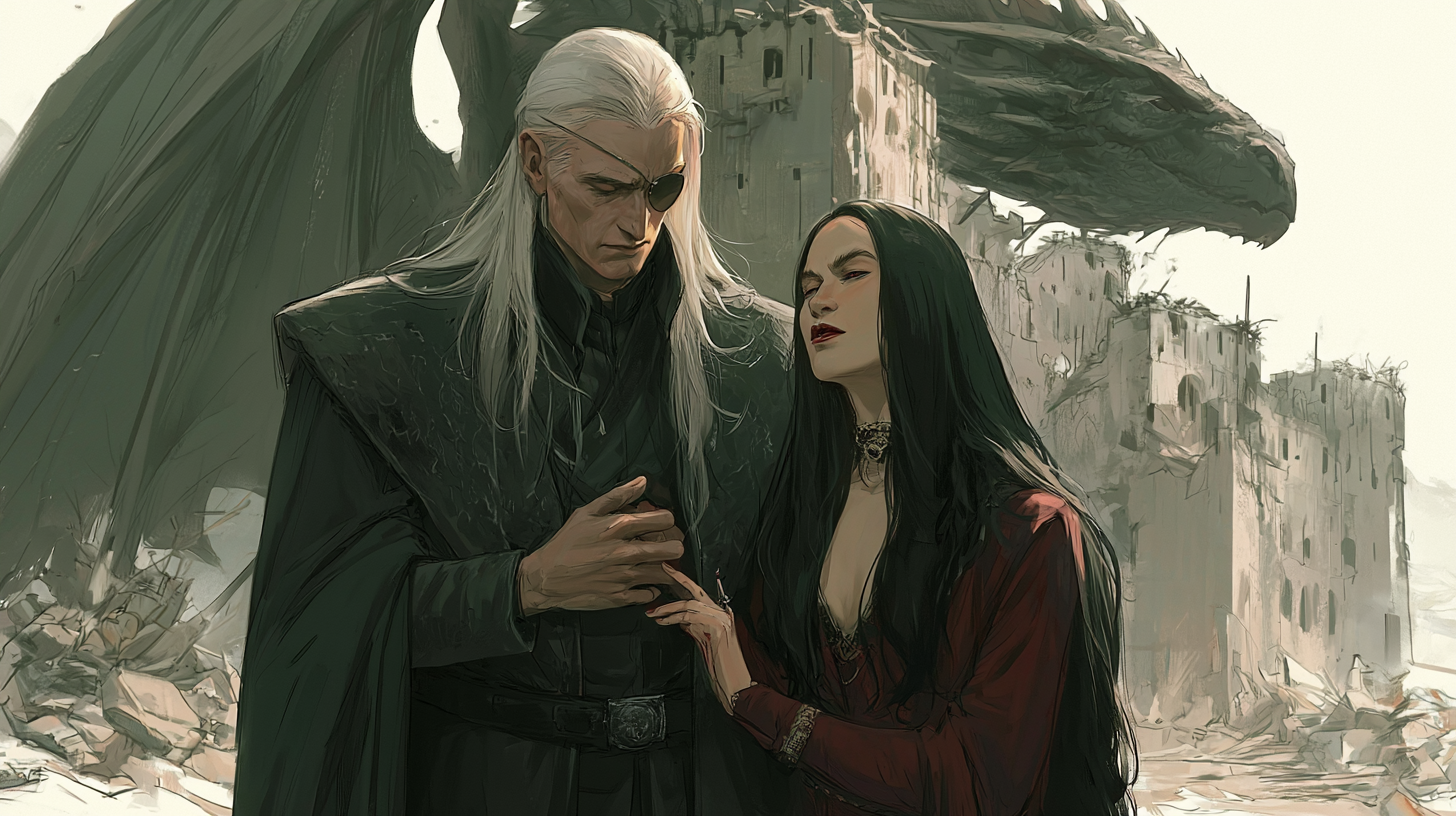
Alys is one of the strangest and most mysterious figures in this part of the story. She is connected to Harrenhal, to visions, to prophecy, and possibly to darker powers. In the book, she becomes Aemond's lover, and she is said to be carrying his child. So when Aemond comes to face Daemon, he is not just a villain flying toward his final boss battle. He is a man leaving something behind.
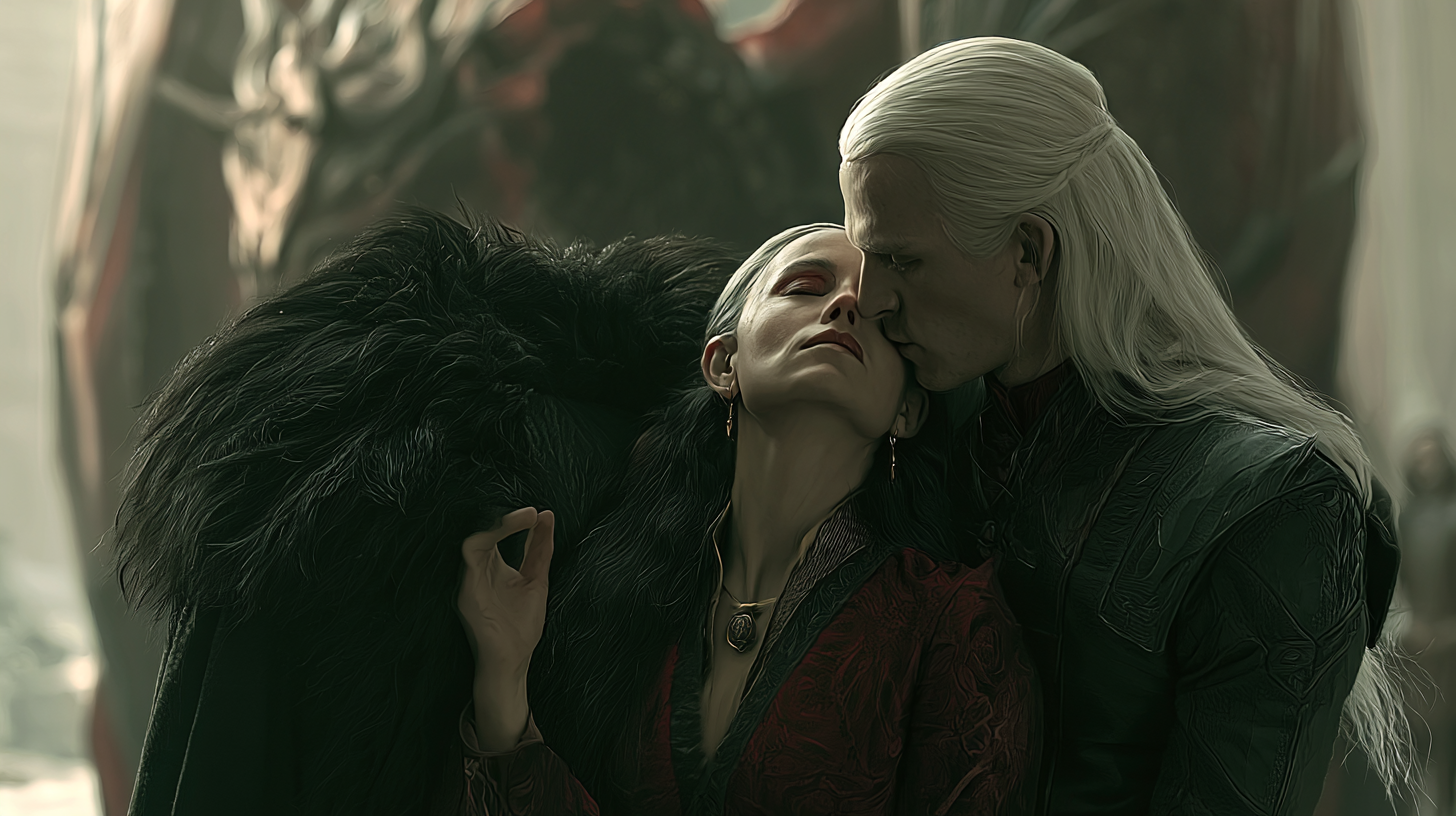
Before the duel, Aemond kisses Alys goodbye. That small moment matters. Because it makes the scene heavier. Aemond is cruel. Aemond is dangerous. Aemond has burned and killed. But in that moment, he is also a man stepping into a fight from which, somewhere deep down, he may know he will not return. Then he mounts Vhagar. Daemon mounts Caraxes. And above the Gods Eye, two of the most dangerous dragonriders in Westeros fly toward each other.
Now, let's pause for a second. Because if you are enjoying this kind of deep dive into the darker corners of Westerosi lore, make sure to like the video and subscribe to the channel. It helps a lot, and it tells me you want more stories like this: dragons, prophecies, cursed castles, doomed princes, and all the beautiful madness that makes this world so addictive.
Now, back to the sky above the Gods Eye.
The Battle Above the Gods Eye
The Blood Wyrm. Smaller, but vicious, fast, and ridden by a man who understands violence better than almost anyone alive. At first glance, Aemond should have the advantage. Vhagar is bigger. Vhagar is stronger. Vhagar has killed dragons before. Aemond has every reason to believe that if this becomes a simple contest of power, he can win.
But Daemon is not there for a simple contest of power. Daemon has a different plan. And this is where the whole scene becomes insane. Aemond is chained to his saddle. That makes sense. Dragon combat is chaos. The dragons twist, dive, turn, and tear at each other in the sky. A rider could easily be thrown off. Chaining yourself to the saddle could be the difference between staying mounted and falling to your death.
Aemond chains himself in because he expects to survive the fight. Daemon does not. Daemon leaves himself unchained. And that tells us everything. Aemond came to win a dragon duel. Daemon came to end a bloodline problem.
The dragons meet in the sky. Vhagar and Caraxes crash together with terrible force. Fire, claws, teeth, wings, blood, two living weapons locked above the lake.
Caraxes attacks Vhagar with everything he has. He cannot simply overpower her. He is not larger. He is not stronger. So he does what Caraxes does best. He latches on. He wraps himself into the fight. He bites, tears, and holds. The dragons are no longer two separate creatures circling each other. They become one falling mass of scale, flame, and rage.
And then Daemon makes his move. While the dragons are locked together, while they are falling, while the sky itself has become a battlefield, Daemon climbs from his saddle. No chain. No safety. No way back. He leaves Caraxes and leaps onto Vhagar. It is reckless beyond reason. But it works. Daemon reaches Aemond. Aemond, chained to Vhagar, cannot escape. Daemon drives Dark Sister through Aemond's eye and into his skull. Aemond One-Eye, the prince whose entire identity was shaped by the eye he lost, dies through the eye that remains.
It is brutal. It is poetic. It is one of the coldest deaths in all of Westeros. There is no speech. No mercy. No long final conversation. Just Valyrian steel, dragonfire, and the fall. Below them, the Gods Eye waits.
Vhagar and Caraxes crash down into the lake. The impact kills them both, or at least seals their deaths. Vhagar, the last great monster of the Conquest, disappears beneath the water. Caraxes manages to drag himself from the lake, broken and dying, before he too perishes.
Aemond is dead. Vhagar is dead. Caraxes is dead. And Daemon is gone. That is one of the most fascinating parts of the story. Aemond's body is eventually found. Years later, they recover him from the lake, still chained to Vhagar's saddle, with Dark Sister still thrust through his skull.
But Daemon's body is never found. And because this is Westeros, where history is written by maesters, singers, survivors, and liars, that missing body creates rumors. Did Daemon die in the fall? Almost certainly. But because no corpse is found, the story refuses to fully close around him. Some say he survived. Some imagine he escaped. Some wonder if he lived out his final days somewhere else.
Why This Death Feels Legendary
But whether Daemon lived or died is almost less important than what the story becomes. Because Daemon does not leave behind a body. He leaves behind an image.
This is why Aemond's death works so well. It is not shocking just because it is violent. It is shocking because it completes him. Aemond begins as the boy without a dragon. Then he claims the greatest dragon alive. He loses an eye and turns that wound into his identity. He becomes proud, dangerous, feared, and almost untouchable. But in the end, the thing that made him powerful also traps him. Vhagar, his greatest weapon, becomes his coffin.
It is a death song for the age of dragons. And when House of the Dragon finally reaches this moment, it has the potential to be one of the most unforgettable sequences in the entire franchise. Because the Dance of the Dragons is not just about who sits the Iron Throne. It is about House Targaryen destroying itself. Dragon by dragon. Heir by heir. Fire by fire. And the Battle Above the Gods Eye may be the purest image of that destruction.
Outro
And that, lore-lovers, is why Aemond Targaryen may have the most metal death in Westeros. If you enjoyed this video, leave a like, subscribe, and share it with another lore-lover who is waiting for the Dance of the Dragons to get even darker.
And tell me in the comments: when House of the Dragon finally adapts the Battle Above the Gods Eye, do you think Daemon's death will be shown clearly, or will they keep the mystery alive?
Also, join our Discord if you want a cozy place to talk about Westeros, dragons, theories, and all the tragic madness of this world. Thanks for watching, and I'll see you in the next one.
Back to Home