


Companion article
Story breakdown and lore notes
The video above is the main focus of this page. The written companion, supporting images, and lore breakdown continue below.
Opening
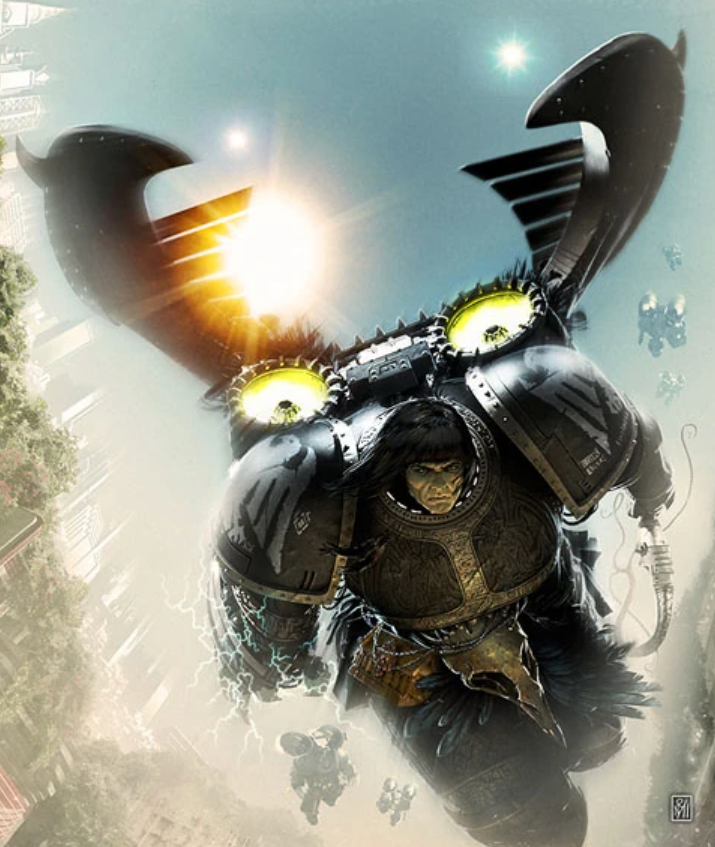
Welcome, lore-lovers, to Liandrug! Today, we're diving into the shadowed history of one of the most intriguing figures in Warhammer 40k--Primarch Corvus Corax.
The Chronicle
Corvus Corax, separated from the Emperor while still an infant, was hurled through the Warp by the Chaos Gods, landing on the barren moon of Lycaeus, the desolate satellite of Kiavahr. This moon, a barren rock without an atmosphere, was home to the miners who toiled under the oppressive rule of Kiavahr's tech guilds. It was these miners, seeking a new vein of ore, who first discovered the infant primarch in a chamber deep beneath the surface.
In a twist of fate, the miners, slaves themselves, took Corax in, hiding him from the cruel overseers. These slaves--criminals, political exiles, and those who had failed to meet their quotas--saw the child as a symbol of hope. They named him "Corax," a word meaning "saviour" in their dialect, and believed that one day he would free them from their harsh lives.
Corax grew rapidly, far faster than any normal human, a sign of his primarch heritage. He learned from his mentors, former radicals who had been imprisoned for opposing the tech guilds, and swore to liberate them from their cruel existence. His time was spent learning patience, observing his foes, and planning for the day when he would lead the uprising.
As he matured, Corax discovered the extent of his abilities. One in particular stood out: the power to become unseen. By willing it, he could pass through the most dangerous areas unnoticed, even in full view of the enemy. However, Corax soon learned that auspexes and other detection systems could still find him, but the minds of those who looked upon him could be tricked into disregarding his presence.
The day came when Corax led the long-awaited rebellion. The prison broke into open revolt, and the battle was fierce. Many of the prisoners had committed heinous crimes, but Corax, seeing the bigger picture, enlisted their help in the struggle. After a bloody fight, the prison was taken, and the shackles of oppression were thrown off. In the aftermath of the battle, the Emperor arrived, not with an army, but alone. The two spoke for hours, though what passed between them remains unknown. Some believe the Emperor may have spoken of the coming darkness, for Corax appeared to have sensed something in the years to come.
The Emperor left Corax to complete the task of liberating Kiavahr, and Corax did so with a mix of cunning and power. Using atomic barrages and mining charges hidden by the guilds, Corax obliterated Kiavahr's cities, understanding that sometimes the innocent must suffer for the greater good. The guilds were forced to surrender, and Lycaeus was renamed Deliverance.
The victory brought Corax closer to his purpose, and soon after, the Mechanicum took control of the world, reestablishing it for the Imperium's benefit. The former prison, now a symbol of freedom, became the site of the Ravenspire, the fortress-monastery of the Raven Guard Legion, marking the beginning of Corax's rise as a leader of the Imperium.
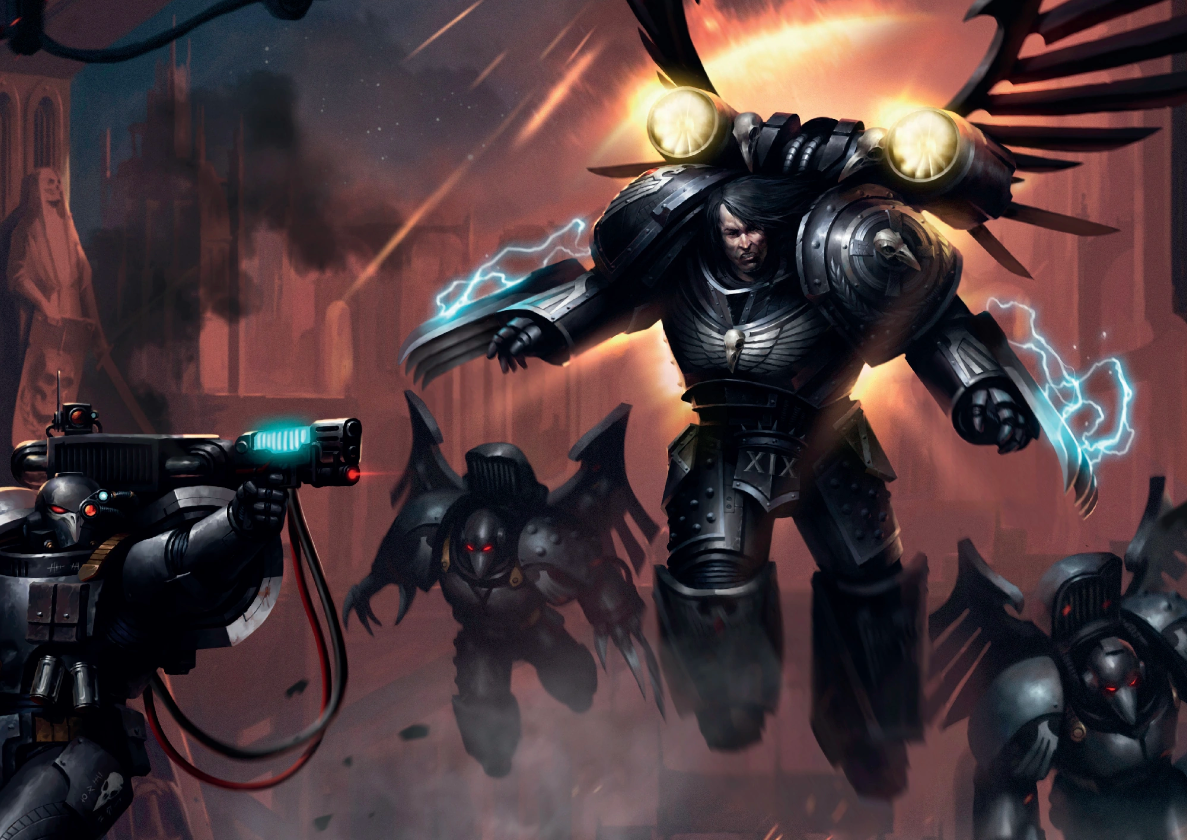
By the time Corax took command of the XIXth Legion, the Great Crusade had been underway for over a century. He quickly imposed his experience from Lycaeus, blending stealth and guile with the Legion's traditions, purging the cold-blooded ways of its Terran origin. Many high-ranking officers were replaced, including Arkhas Fal, who had led the Legion for decades. Under Corax's guidance, the Raven Guard's skills reached new heights. Corax even defeated Guilliman in a strategio-simulacra, though Guilliman adapted and never lost to him again.
Corax's restructuring also brought technological innovations, like the nearly invisible Shadowhawk gunship and the Whispercutter, a silent flyer for dropping troops. These were created by Kiavahran artificers, independent of Mars, whose secrecy was preserved under Corax's patronage. Kiavahr maintained a unique relationship with the Legio Gryphonicus, although the details remained unclear.
In the Istvaan System, Corax's Raven Guard brought Istvaan III into Imperial compliance, overcoming the planet's mystical and independent culture. After a precise assault, the Istvaanians surrendered and joined the Imperium, though Corax would later return to face Horus on Istvaan V, fifteen years after the campaign.
The Battle of Gate Forty-Two proved one of the darkest hours for the Raven Guard. After Horus became Warmaster, Corax opposed a frontal assault on the Unsighted Kings, proposing a strategic feint. He was overruled, and the Raven Guard suffered heavy losses, though they eventually breached the gate. Corax, disillusioned, swore never to fight alongside Horus again. The battle also eliminated many of the Terran-born officers, weakening the Raven Guard's connection to Horus and removing the influence of the Warrior Lodges.
Hey, lore-lovers! If you're enjoying the story, don't forget to hit that like button and subscribe. By supporting the channel, you're helping Liandrug grow, and that means more lore-filled videos for you to enjoy. Let's keep this community thriving!
During the Scalland Sector campaign, the Raven Guard tested the new Mark VI Power Armour against the Eldar, utilizing its advanced agility and auto-senses to great effect. Despite initial doubts about its durability, the armour proved highly effective, leading to its approval and eventual renaming to Corvus Pattern. This success was a crucial contribution to the Raven Guard before the outbreak of the Horus Heresy.
During the Horus Heresy, the Drop Site Massacre on Istvaan V marked a pivotal and bloody moment. The Emperor had sent seven Loyalist Legions to crush the rebellion led by Horus and the Traitor Legions. The Iron Hands, Salamanders, and Raven Guard were the first to assault the Traitors. Primarchs Ferrus Manus, Vulkan, and Corax led their respective Legions, attacking the enemy from different flanks. Despite the evenly matched forces of 40,000 Loyalists against 30,000 Traitors, the Traitors were well-prepared, knowing the Loyalists' drop site.
As the battle raged, the Loyalists initially held the line, but Ferrus Manus disregarded his brothers' advice, charging forward in a personal pursuit of Fulgrim. This decision led to the tragic deaths of many of the Iron Hands' elite troops. The battlefield, choked with thousands of Astartes warriors, saw the mighty Primarchs fight fiercely. Corax soared above, Vulkan struck down foes with his hammer, and Ferrus Manus cleaved through his enemies. On the opposite side, the traitorous Primarchs -- Angron, Fulgrim, Mortarion, and Horus -- wrought devastation of their own.
Despite the ferocity of the Loyalist charge, a deadly trap was set. Horus had secretly sent in the Night Lords, Iron Warriors, Word Bearers, and Alpha Legion in the second wave, their true loyalties to Chaos. These "Loyalists" slaughtered the unsuspecting Raven Guard and Salamanders, who were still reeling from the initial assault. Ferrus Manus and Vulkan tried to retreat, but the betrayal was complete.
The Raven Guard, led by Corax, faced the Word Bearers, with Lorgar leading the charge. Amidst the chaos, Corax fought fiercely, his rage directed at the traitors who once stood with him. But as he battled Lorgar, Corax was interrupted by Konrad Curze, the Night Haunter, who intervened to save Lorgar from death, mocking Corax's retreat. In the end, the Raven Guard, alongside the Salamanders, were overwhelmed, the odds stacked against them.
The Drop Site Massacre dealt a fatal blow to the Loyalists, leaving them shattered and surrounded. Though the Loyalists fought valiantly, the Traitors had claimed victory, and the path to Terra was now wide open, setting the stage for the Siege of the Imperial Palace.
Surviving the crash on Istvaan V, Corax quickly regrouped his remaining Raven Guard forces. Devastated by the slaughter of his Legion, they sought refuge in the highlands, hiding in shadows to avoid pursuit. An ambush on a column of Iron Warriors briefly offered respite. With no contact from the Iron Hands or Salamanders, Corax ordered a stand at Lurgan Ridge while he embarked on a reconnaissance mission to evaluate the drop site. Though his mission was officially to survey enemy positions, his true purpose was to search for the bodies of his fallen brothers, though he found none.
After nearly three months of relentless pursuit, the Raven Guard was cornered on a windswept mountainside. The World Eaters, led by Angron, massed ahead, a fury of bloodlust and rage charging toward the last of Corax's warriors. Just as their destruction seemed inevitable, Raven Guard drop ships arrived, unleashing a furious counterattack that allowed the survivors to escape the World Eaters' bloodthirsty reach.
Wounded and broken, Corax was transported to Terra. He healed, but the loss of his Legion haunted him. In deep reflection, he realized that, had fate turned differently, he could have been like Konrad Curze--consumed by rage and terror. Determined to rebuild the Raven Guard, Corax communed with the Emperor, who revealed the truth about the Heresy, Chaos, and the existence of undisturbed Primarch gene-stock.
Aided by Adeptus Mechanicus and Custodes, Corax located the gene-laboratories beneath the Imperial Palace, securing the genetic assets. With new Astartes gene-seed, Corax began to rebuild his Legion. However, the Alpha Legion had plans of their own. They infiltrated the process and contaminated the Primarch gene-seed with a Warp-tainted virus, creating hideous mutations. Despite this, Corax refused to abandon them and sought a cure.
The Alpha Legion's sabotage crippled the Raven Guard's genetic progress, but the mutants, though cursed, were integrated into the Legion. When the rebellion on Kiavahr escalated, Corax allowed Branne to take action to prevent further disaster. As the Raven Guard fought on, Corax's struggle to rebuild his Legion seemed in vain. He ultimately concluded that rebuilding through traditional methods was the only way forward, even if it meant that the Raven Guard would not be able to fully participate in the war. The Legion was divided during the Second Founding, but Corax, tormented by guilt, personally executed the aberrant mutants. Unable to bear the weight of his actions, he locked himself away, eventually disappearing from Deliverance to seek redemption in the Eye of Terror.
After his disappearance, Corax embarked on a personal quest to track down Lorgar. On the daemon world of Sicarus, Lorgar had changed, becoming a monstrous figure draped in Chaos power. Corax, too, had evolved, now a creature of shadow and wings, capable of transforming into a flock of ravens. Their clash was fierce, but once again, Corax gained the upper hand. Lorgar retreated to his sanctum, but Corax vowed to find him, no matter how long it took. The black door of the temple bore a final message: "Deny Fate."
Closing Words
Thanks for joining me, lore-lovers! If you enjoyed the video, make sure to like, share, and subscribe to keep the lore flowing. And if you want to dive even deeper into the world of Warhammer and beyond, join the Liandrug Discord community where we create a cozy, welcoming environment for all of us to discuss our favorite stories. Until next time, keep the lore alive!
Back to Home