


Companion article
Story breakdown and lore notes
The video above is the main focus of this page. The written companion, supporting images, and lore breakdown continue below.
The Chronicle
Loki, possessing undeniable charm, was acutely aware of his allure. Despite people's desire to admire and trust him, his nature was inherently unreliable and self-centered, bordering on mischief or even malevolence. His union with Sigyn, once marked by her happiness and beauty, now seemed clouded by perpetual anticipation of dire tidings. From this union came two sons, Narfi and Vali.
Periodically, Loki would vanish for stretches, leaving Sigyn to brace herself for the worst, only for him to return, bearing an air of dubious satisfaction with himself. This pattern repeated thrice, with Loki's returns marked by a blend of shiftiness, guilt, and smugness.
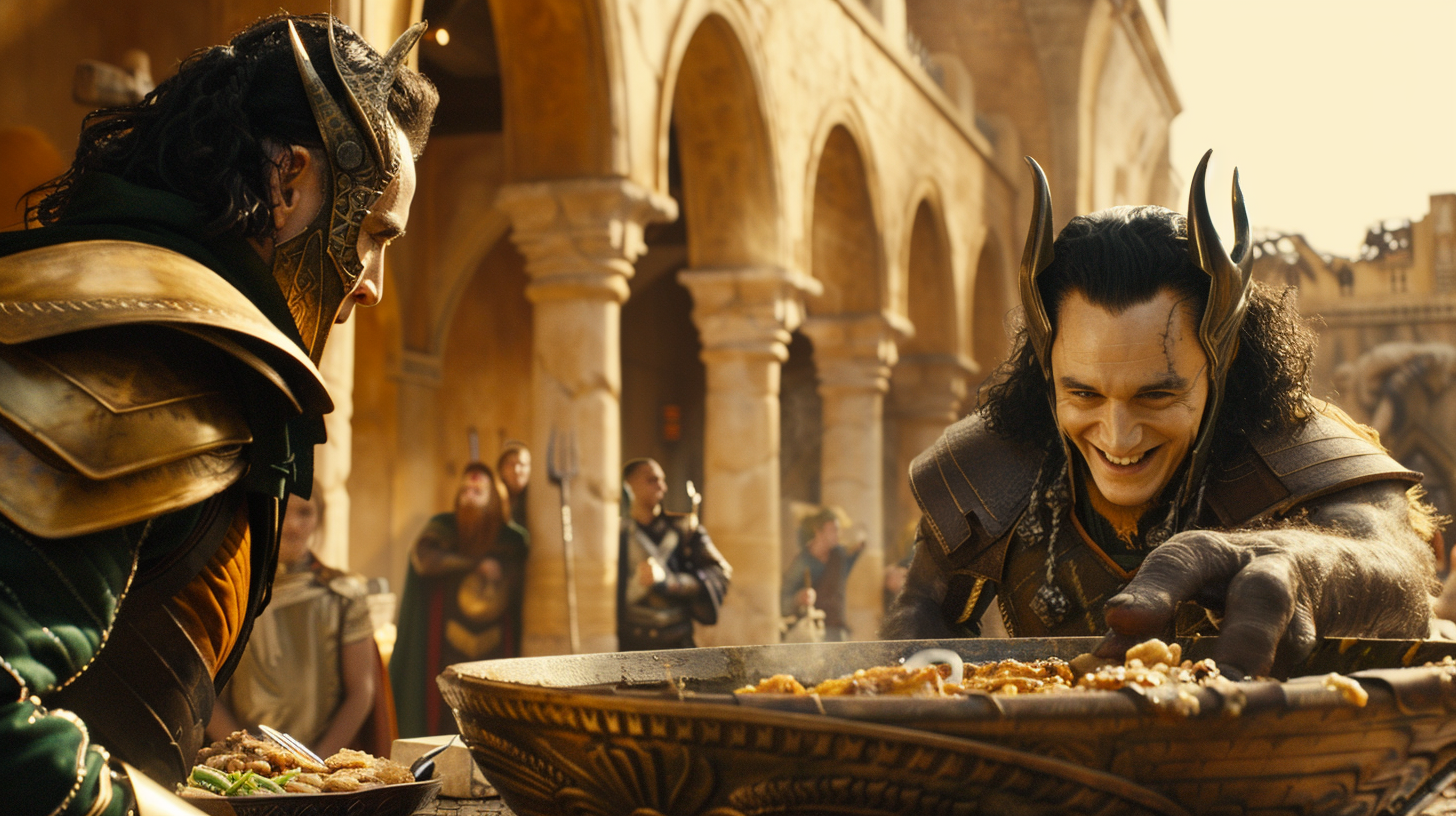
Upon Loki's third return to Asgard, Odin summoned him, revealing a prophetic dream: Loki had fathered three children with Angrboda, a giantess from the frost giant realm. These offspring, foreseen by Odin as the gods' greatest adversaries in the future, would emerge as formidable foes in times to come.
Loki remained silent, attempting to feign shame but inadvertently betraying his self-satisfaction.
Odin convened the gods, with Tyr and Thor leading the assembly, informing them of their mission to journey deep into Jotunheim, the realm of the giants, to retrieve Loki's offspring.
The gods ventured forth into the perilous land of the giants, encountering numerous hazards until they reached Angrboda's stronghold. Unprepared for their arrival, Angrboda had left her children playing in her grand hall. Despite the shocking sight of Loki and Angrboda's offspring, the gods pressed on, seizing the children and binding them for transport back to Asgard.
During their return journey, Thor and Tyr noticed the absence of pursuit from the giants, suggesting an eerie acquiescence to the gods' actions.
After days of arduous travel, they presented Loki's children before Odin. The eldest, named Jormungundr, had grown significantly during the journey, now resembling a massive serpent. Odin decided to release Jormungundr into the boundless sea, where it would eventually become known as the Midgard Serpent.
Turning his attention to Loki's daughter, Odin observed her disconcerting appearance: one side of her face retained beauty akin to Loki's features, while the other side bore the ghastly marks of death and decay.
"What is your name, young one?" inquired the all-father.
"They call me Hel," she responded, "if it pleases you, All-father."
"You possess manners," remarked Odin. "I'll grant you that."
Hel remained silent, her gaze fixed upon him with a sharp, icy green eye, alongside her lifeless, pallid one. There was no fear evident in her demeanor.
"Are you among the living?" Odin pressed further, "Or are you a creature of the dead?"
"I am simply myself, Hel, offspring of Angrboda and Loki," she replied. "And I prefer the company of the dead. They are straightforward and treat me with reverence. The living often regard me with disgust."
Contemplating her words and recalling his prophetic dreams, Odin declared, "This child shall rule over the darkest realms, governing the departed across all nine worlds. She shall be the sovereign of those souls who meet their end through unfortunate means--disease, old age, accidents, or childbirth. Warriors fallen in battle shall find their place in Valhalla. But those who perish in other ways shall belong to her, to serve in her realm of shadows."
For the first time since her separation from her mother, Hel displayed a semblance of a smile, albeit with only half her mouth.
Odin escorted Hel to her realm of perpetual darkness, revealing the vast hall where she would reign and allowing her to name her possessions. "This bowl shall be named Hunger," she declared, holding it up. "This knife, Famine. And my bed, Sickbed."
Thus, two of Loki's children with Angrboda were settled--one cast into the depths of the ocean, the other into the abyss beneath the earth. But what fate awaited the third?
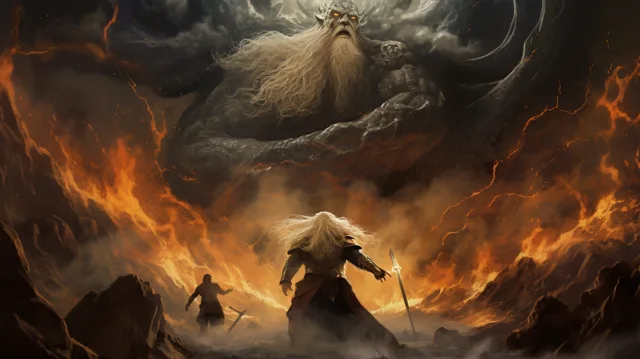
Upon their return from the land of the giants, the smallest of Loki's offspring was akin to a puppy in size. Tyr, playing with it, removed its willow muzzle. This wolf cub, named Fenrir, consumed its meat raw yet spoke with the eloquence of men and gods, exuding pride in its demeanor.
But Fenrir's growth was rapid, transforming from wolf to the size of a cave bear, then to that of a great elk, in mere days.
The gods, except for Tyr, were daunted by the wolf's increasing size and strength. Tyr continued to interact with the wolf, feeding it daily and playing with it, despite its rapid growth and escalating ferocity.
Odin observed the wolf-child's development with apprehension, as it had appeared ominously in his dreams, signifying the end of all things.
In council, the gods decided to bind Fenrir, crafting heavy chains and shackles in their forges. Presenting the chains as part of a game, they challenged Fenrir to test his strength.
Fenrir accepted the challenge, allowing the gods to wrap the chains around him. With a mighty effort, he effortlessly broke free, declaring his triumph and warning the gods not to underestimate him.
Undeterred, the gods prepared stronger chains, forged with the heaviest and most resilient metals, naming them Dromi. Despite Tyr's warning, Fenrir anticipated another test of his strength.
The gods presented the challenge to Fenrir, promising him unrivaled renown and glory should he break free from the formidable chains named Dromi. Fenrir, acknowledging the risk inherent in seeking glory, consented to be bound.
With immense effort, Fenrir initially struggled against the chains, eliciting a sense of triumph among the gods. However, as he intensified his efforts, the chains began to strain and eventually shattered with such force that the fragments were scattered far and wide.
Fenrir, exulting in his victory, noted the gods' lack of apparent joy, including Tyr. This observation lingered in Fenrir's thoughts as he continued to grow in size and hunger with each passing day.
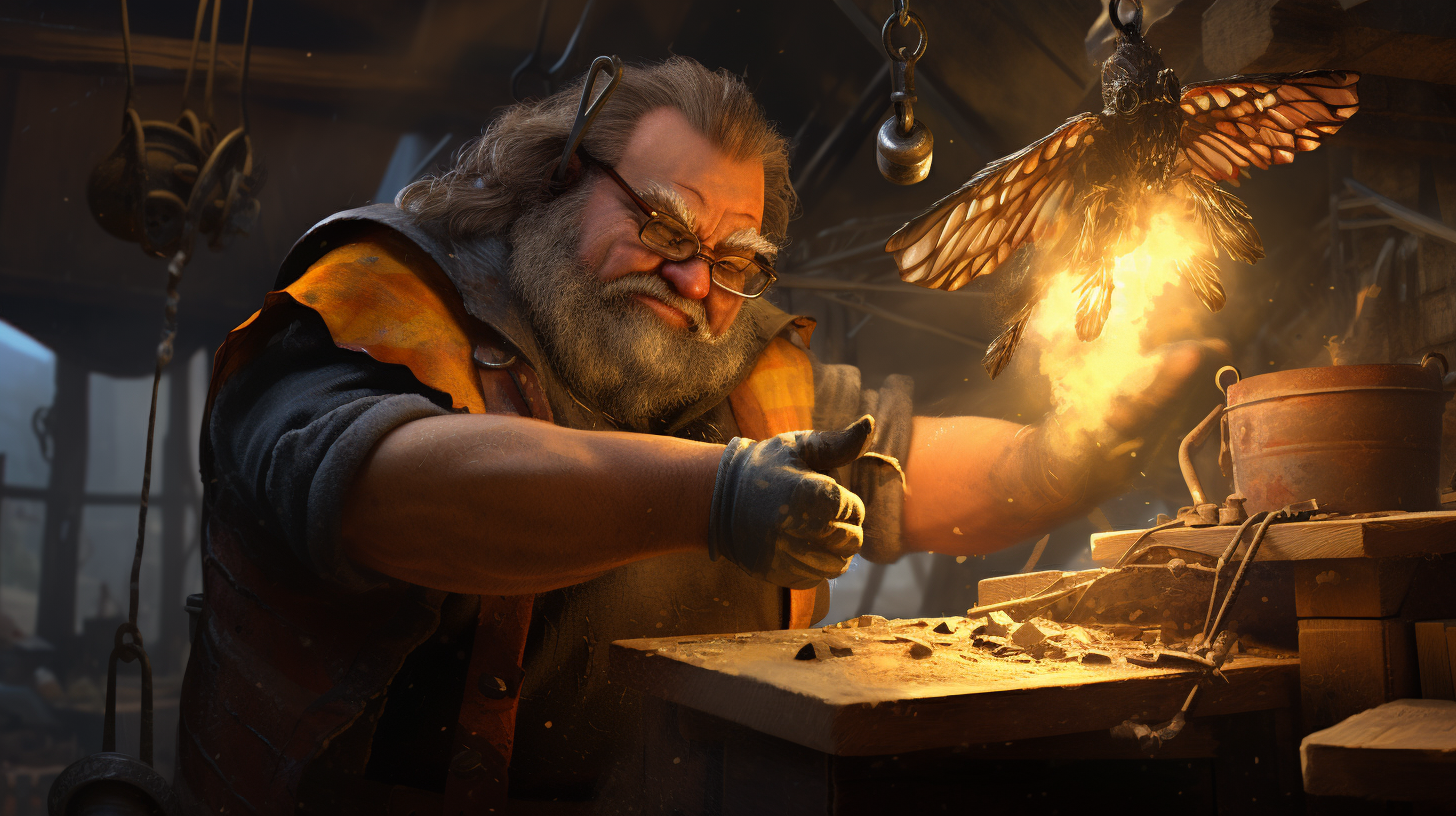
Meanwhile, Odin, drawing upon his vast wisdom, devised a plan to contain Fenrir. He enlisted the aid of Skirnir, Frey's messenger, to commission the creation of a unique chain named Gleipnir from the dwarfs in Svartalfheim. Despite the dwarfs' reluctance and high price, Skirnir agreed to their terms on Odin's instruction, and the dwarfs began the preparations for crafting Gleipnir.
The dwarfs embarked on a quest to gather the six rare ingredients needed for Gleipnir's creation:
Firstly, they sought the footsteps of a cat.
Secondly, they sought the beard of a woman.
Thirdly, they sought the roots of a mountain.
Fourthly, they sought the sinews of a bear.
Fifthly, they sought the breath of a fish.
Lastly, they sought the spittle of a bird.
Utilizing these unconventional components in their craftsmanship, the dwarfs fashioned Gleipnir, a seemingly delicate yet incredibly strong band, nearly weightless and translucent to the eye.
Returning to Asgard with the finished product, Skirnir unveiled Gleipnir to the astonishment of the gods. Together, they summoned Fenrir to the shores of the Black Lake and presented the bond as an unbreakable restraint.
Confident in his strength, Fenrir scoffed at the seemingly flimsy band. However, as the gods demonstrated its durability by attempting to break it to no avail, Fenrir remained unimpressed, dismissing it as insignificant compared to his abilities.
Insisting on real, heavy chains, Fenrir refused to acknowledge Gleipnir's strength, eager to display his power with conventional restraints.
"This is Gleipnir," Odin declared. "It surpasses any chains or fetters. Are you afraid, Fenrir?"
"Fear?" scoffed Fenrir. "Not at all. But what glory is there in breaking a flimsy ribbon like that? Will people praise my strength for snapping a silken band?"
"You are afraid," Odin insisted.
Detecting deception, Fenrir's amber eyes gleamed in the moonlight. "I smell trickery and deceit," he growled. "Though I may see Gleipnir as a mere ribbon, I will not consent to be bound by it."
"Scared by this band?" Thor interjected incredulously. "You, who broke the mightiest chains? You fear this ribbon?"
"I fear nothing," Fenrir retorted. "Perhaps it is you little creatures who fear me."
Odin acknowledged Fenrir's reluctance, understanding the wolf's hesitation to be restrained by unbreakable bonds. He assured Fenrir that if he failed to break the ribbon, the gods would release him without consequence.
But Fenrir remained skeptical, accusing Odin of deceit and betrayal. He proposed a test: one of the gods must place their hand in his mouth while he was bound. If he escaped Gleipnir or was freed without harm to the hand, there would be no treachery.
Odin accepted the challenge, acknowledging Fenrir's bravery but also viewing it as a cover for his underlying fear. With a sinister grin, Fenrir dared the gods to prove their intentions.
Fenrir's laughter echoed as he displayed his formidable teeth, challenging the gods to prove their innocence. He proposed a test: one of the gods must place their hand in his mouth while he was bound. If no treachery was intended, he would refrain from biting down, thus proving the gods' trustworthiness.
The gods hesitated, exchanging glances, but none stepped forward. Eventually, Tyr, Odin's son, volunteered, recalling their playful interactions from Fenrir's puppy days.
With Tyr's hand in his mouth, Fenrir closed his teeth gently, holding it in place without harm. The gods then bound Fenrir with Gleipnir, a shimmering ribbon-like restraint that rendered him immobile.
Encouraged by Odin, Fenrir attempted to break free, but each struggle only seemed to strengthen the bond further. Initially amused, the gods eventually burst into laughter, except for Tyr, who remained silent, feeling Fenrir's teeth against his wrist and the warmth of his tongue.
As Fenrir lay still, awaiting release, the gods continued to laugh, oblivious to Tyr's bravery. With a nod from Tyr, Fenrir bit down on his wrist, severing it without a sound.
Ignoring Tyr's sacrifice, the gods secured Gleipnir, threading it through a massive stone and anchoring it deep underground, ensuring Fenrir's imprisonment for eternity.
"Foul Odin!" bellowed Fenrir. "Your deceit has cost you my allegiance. I would have been a friend to the gods if not for your treachery. But fear has clouded your judgment. I will hunt you down, All-Father. At the end of days, I shall devour the sun and the moon, relishing most in your demise."
The gods, wary of Fenrir's snapping jaws, continued to drive the rock deeper into the ground. In a sudden lunge, Fenrir attempted to attack them, but a quick-thinking god thrust his sword into the wolf's mouth, wedging it open and preventing it from closing.
As saliva poured from Fenrir's mouth like a river, the gods retreated from the scene, leaving behind the grotesque sight. Although they remained silent at first, once they were at a safe distance, they erupted into laughter, congratulating themselves on their perceived cleverness.
Tyr, however, remained solemn, tending to his injured wrist as he accompanied the gods back to Asgard, harboring his own thoughts.
Thus, these were the offspring of Loki.
Closing Words
Thank you for joining us on this epic adventure through the myths of Norse folklore. Don't forget to like, share, and subscribe to Liandrug for more captivating tales. And for deeper discussions with fellow lore-lovers, be sure to join our Discord channel. Until next time, may the legends of the past continue to inspire us.
Back to Home