


Companion article
Story breakdown and lore notes
The video above is the main focus of this page. The written companion, supporting images, and lore breakdown continue below.
The Chronicle
Norse mythology boasts a multitude of divine figures, and you'll encounter a significant number of them within these texts. Nonetheless, the majority of our tales revolve around a trio of deities: Odin and his son Thor, accompanied by Loki, a giant's offspring who shares a deep bond of blood brotherhood with Odin. Loki, despite his giant origins, resides among the Aesir in the realm of Asgard.
Odin, the eldest and most supreme of all the gods, possesses a profound reservoir of knowledge and secrets. His insatiable thirst for wisdom led him to make extraordinary sacrifices in his pursuit of enlightenment. He famously forfeited an eye in exchange for wisdom, and he endured a grueling nine-day, nine-night ordeal, hanging from the world-tree Yggdrasil. During this excruciating experience, a spear pierced his side, and the winds relentlessly battered his frail form. He abstained from sustenance and hydration throughout this time, teetering on the brink of death, until a breakthrough occurred in the midst of his agony. In a moment of transcendental insight, Odin gazed downward and the runes, ancient symbols of power, were unveiled to him. He comprehended their significance and control. At that pivotal juncture, the rope severed, and he plummeted from the tree, screaming. Now endowed with magic and a newfound understanding of the world, Odin embarked on his journey as a deity of immense influence.
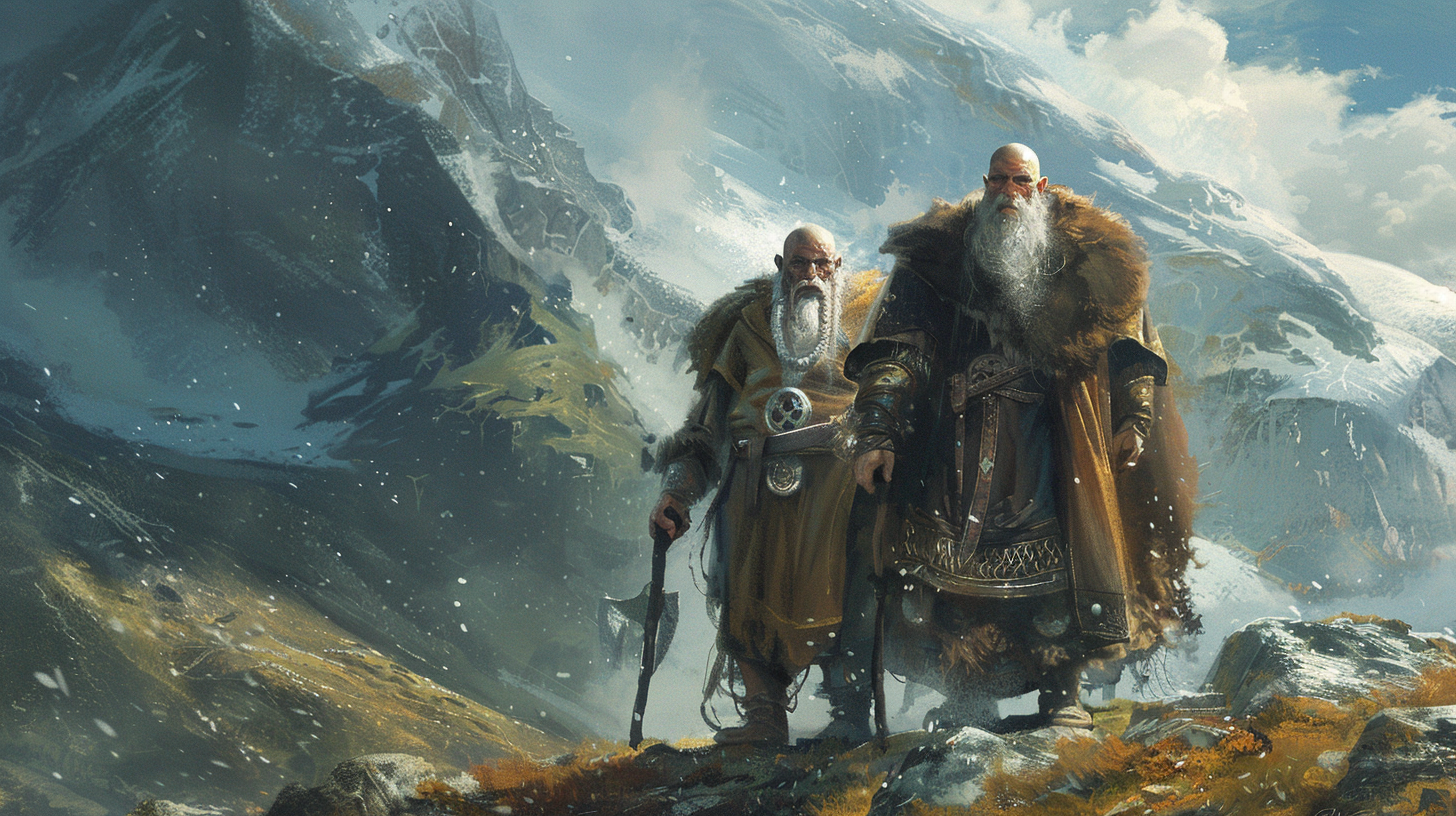
Odin goes by many titles, including the All-Father, Lord of the Slain, and Gallows God. He presides over matters related to cargoes and prisoners. He bears different appellations in various lands, adapting to the diverse forms of worship. As he travels in disguise, he often assumes the guise of a tall man adorned with a cloak and hat.
Two ravens, named Huginn and Muninn, serve as his loyal companions, symbolizing thought and memory. These avian messengers traverse the globe, gathering news and conveying their findings to Odin, who listens attentively as they perch upon his shoulders, whispering their insights into his ears.
Seated upon his lofty throne at Hlidskjalf, Odin possesses an omniscient perspective, observing all occurrences, no matter how distant or hidden.
Odin, often associated with the inception of warfare, inaugurates battles by casting a spear at the enemy forces, dedicating the ensuing conflict and its fatalities to himself. Survival in battle is attributed to Odin's favor, while those who fall believe they have been betrayed by him.
For those who valiantly perish in combat, the Valkyries, magnificent battle-maidens who gather the souls of the heroic deceased, transport them to the illustrious hall of Valhalla. There, Odin awaits them, and in this divine realm, they engage in revelry, combat, feasting, and merriment, with Odin as their leader.
Thor, the son of Odin, assumes the formidable mantle of the thunder. In stark contrast to his father Odin's cunning nature, Thor is characterized by his straightforward demeanor and good-natured disposition. He possesses imposing physicality, towering in stature with a fiery red beard, and stands as the mightiest among all the gods. His already formidable strength is magnified by his enchanted belt of power, known as Megingjord, which bestows upon him the ability to double his might when worn.
Thor wields a remarkable weapon, Mjollnir, a hammer meticulously crafted for him by dwarfs. The tales of its creation hold their own intrigue. at the mere sight of Mjollnir, trolls, frost giants, and mountain giants quiver in fear, as it has claimed the lives of countless of their kin and comrades. Thor dons iron gloves that facilitate his firm grip on the hammer's handle.
Born to Jord, the earth goddess, Thor is the father of Modi, characterized by his fiery temperament, and Magni, renowned for his incredible strength. Thor also has a daughter named Thrud, whose power is truly formidable. His spouse is Sif, known for her radiant golden hair. Before her marriage to Thor, Sif had a son named Ullr, making Thor Ullr's stepfather. Ullr, a god renowned for his prowess in archery and skiing, embodies a unique set of skills.
Thor's noble duty involves defending both Asgard and Midgard, showcasing his unwavering dedication to safeguarding these realms. Numerous tales recount Thor's heroic exploits and adventures, some of which you will encounter within these pages.
Loki possesses an undeniable allure with his striking handsomeness, a persona that exudes plausibility, charm, and likability. Yet beneath this faade lies a profound darkness--an abyss filled with anger, envy, and insatiable lust. Among the inhabitants of Asgard, Loki stands as the paragon of cunning, subtlety, and shrewdness.
Born to Laufey, also known as Nal or "needle" due to her slim, sharp beauty, and to Farbauti, whose name signifies "he who strikes dangerous blows," Loki's lineage is shrouded in danger and intrigue. Farbauti, his giant father, lived up to his name's perilous implications.
Loki's unique abilities include the ability to traverse the sky with flying shoes and shape-shifting, enabling him to assume the appearance of others or transform into animals. However, his most formidable weapon is his intellect, which surpasses that of any god or giant, even rivaling Odin in sheer cunning.
As Odin's blood brother, Loki's arrival in Asgard remains a mystery to the other gods. He maintains a complex relationship with Thor, serving as both a friend and a betrayer. While tolerated by the gods, Loki's stratagems and schemes frequently rescue them from peril, though they are just as likely to plunge them into trouble.
Loki adds an element of intrigue to the world, albeit at the cost of safety. He bears responsibility for fathering monsters and authoring various calamities, cementing his reputation as the sly god.
Notably, Loki's penchant for excessive drinking renders him unable to restrain his words, thoughts, or deeds when inebriated. He and his progeny are destined to play a pivotal role in Ragnarok, the cataclysmic end of all things, and their allegiance will not align with the gods of Asgard.
Before creation, there was nothing but the mist world and the fire world. To the north lay Niflheim, a dark and frigid realm with eleven poisonous rivers flowing from a central well called Hvergelmir. Murky mist shrouded everything, obscuring the skies and chilling the land.
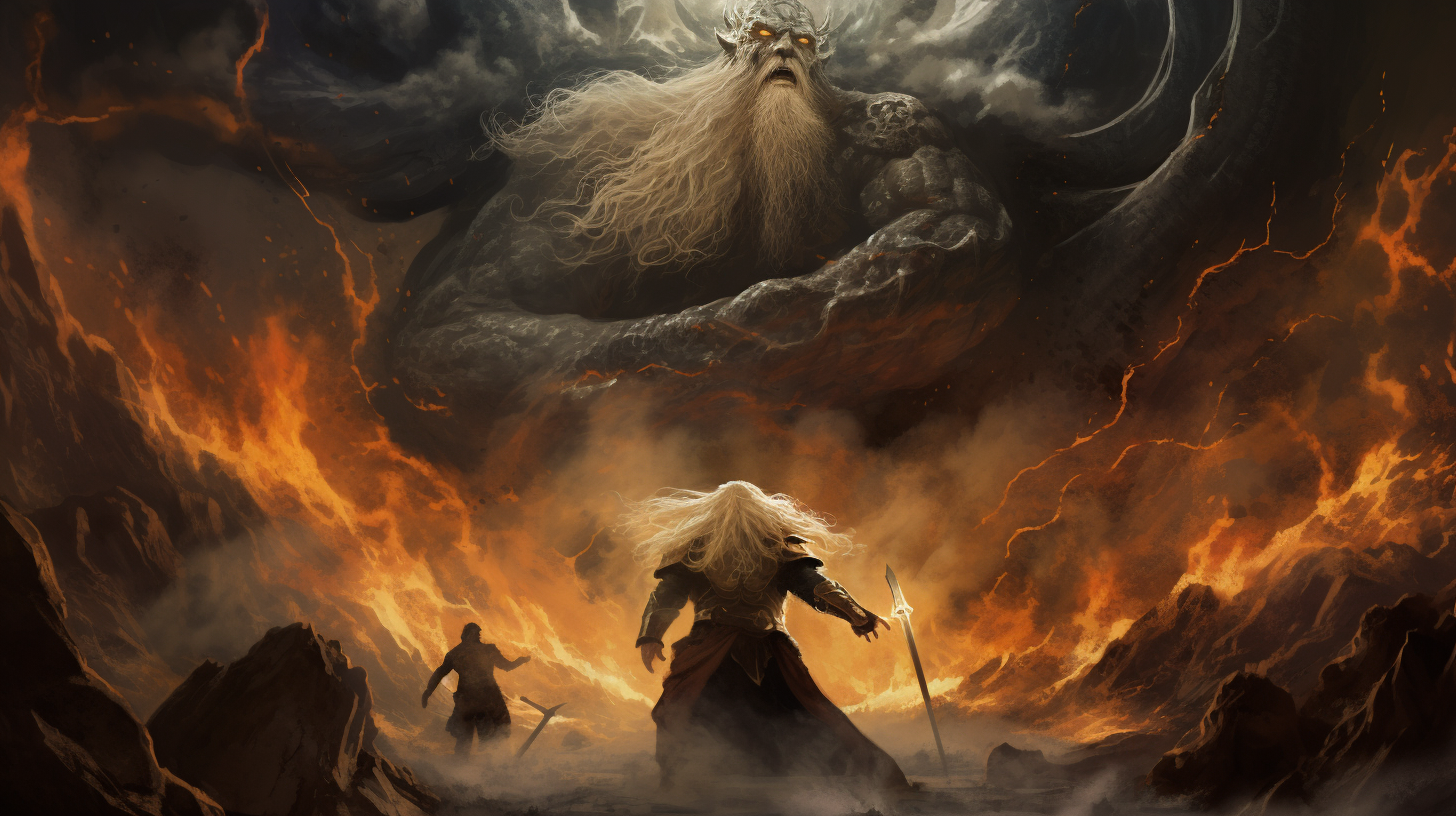
To the south was Muspell, a fiery expanse where everything glowed and burned. It was a land of molten lava and scorching heat, in stark contrast to the frozen mist world. Surtr, an ancient being predating the gods, stood at its fiery edge, wielding a blazing sword.
Legend has it that during Ragnarok, the world's end, Surtr will depart from Muspell, wielding his flaming sword to unleash fire upon the world, leading to the fall of the gods one by one.
Between Muspell and Niflheim, a void named Ginnungagap formed. Over ages, mist rivers turned into massive glaciers, shrouding the north in fog and hail, while the south's warmth from Muspell made the air above the ice pleasant.
Melting ice gave rise to life--a gender-fluid being named Ymir, the forebear of giants, and a massive cow named Audhumla. Audhumla's milk nourished Ymir, who grew. Audhumla's tongue shaped a man named Buri, the gods' ancestor. Ymir's sleep led to the birth of giants, from whom all giants descend. Buri married a giant, had a son named Bor, who wed Bestla, a giant's daughter, and together they had Odin, Vili, and Ve.
Odin, Vili, and Ve, the sons of Bor, matured and observed the distant flames of Muspell and the darkness of Niflheim, realizing that both were deadly to them. They found themselves eternally trapped in Ginnungagap, an empty void devoid of sea, sand, grass, rocks, or any semblance of a world. In this emptiness, they recognized the need for creation.
In the void of Ginnungagap, the brothers deliberated on the universe, life, and the future. Recognizing the necessity of their actions, Odin, Vili, and Ve slew the giant Ymir. This momentous act marked the genesis of all existence--a death that paved the way for life to flourish.
The god brothers slayed Ymir by stabbing him and from his blood a great flood was created, drowning all giants save from Bergelmir (Ymir's grandson) and his wife that were fortunate enough to float on a wooden box. From them emerged all the other giants that the gods will be afraid off.
Odin and his brothers made the soil from Ymir's flesh and the mountains for his bones and all the sands and gravel are Ymir's teeth and fragments of bones that emerged after their battle with the giant.
The seas are Ymir's blood and sweat. The sky is Ymir's skull, hosting stars, planets, comets, and clouds originating from Muspell's sparks and Ymir's brains, their thoughts a mystery.
The world is a flat disk encircled by the sea, with giants dwelling at its edges. To protect against the giants, Odin, Vili, and Ve constructed a wall using Ymir's eyelashes, creating a region called Midgard.
Midgard remained vacant and unexplored. Odin, Vili, and Ve sought inhabitants but found none. Finally, they discovered two logs washed ashore--a sturdy ash log and another of elm wood.
The second log, placed next to the first on the beach, was made of elm wood, known for its toughness. The gods took both logs, stood them upright, and Odin breathed life into them. Vili granted them will and intelligence, while Ve carved them into human shapes with senses.
The two logs, now living, stood as naked people. Ve carved one as male, the other as female. The gods provided clothing and named them Ask (Ash Tree) and Embla (Elm).
Ask and Embla became the ancestors of all humanity, sheltered within Midgard behind the protective wall of Ymir's eyelashes. They settled there, raising their children in peace, safe from giants and monsters. This is why Odin is known as the all-father, as he breathed life into our distant ancestors, whether gods or mortals, making him the father of us all.
Closing Words
As our journey through the realms of Norse Mythology comes to an end, only for this video, fo course, I hope you've enjoyed exploring these tales. Stay around for more video about Norse Mythology that are to come. Don't let the adventure stop here--stay tuned for more legendary stories. And remember, lore-lovers, to subscribe, share, and like our channel to keep the spirit of Norse mythology alive in your heart. Until next time, may the gods watch over you on your own mythic quests!
Back to Home